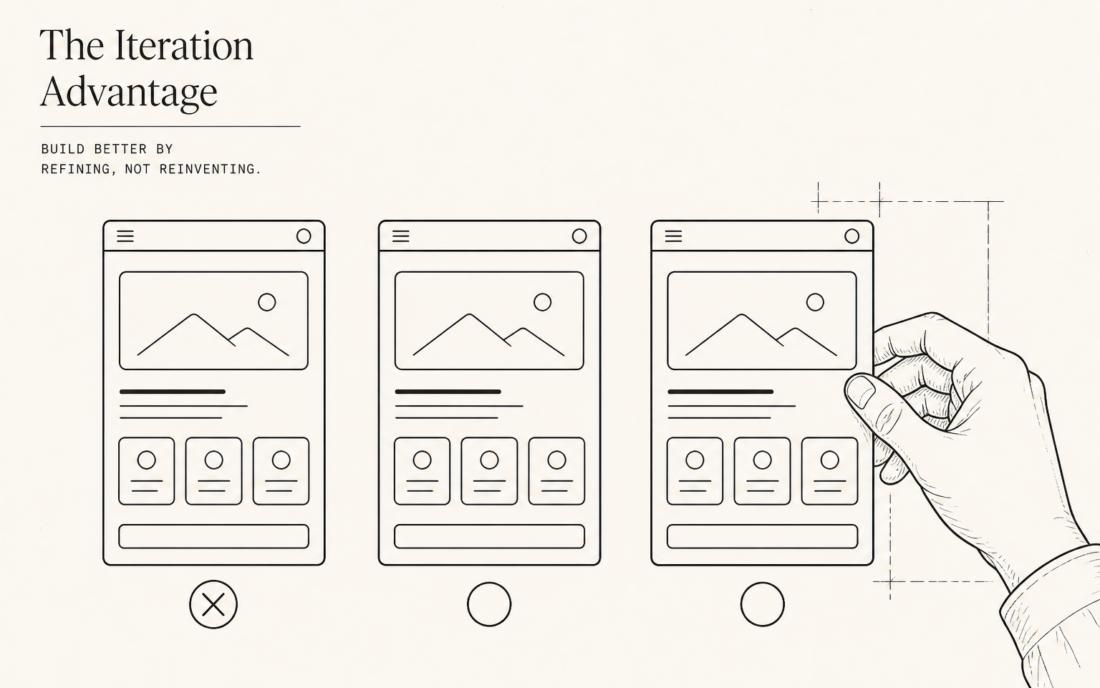
There is a new genre of software: the “perfectly fine” app that still gives itself away immediately. You open it and think: ah. Inter. Or something that wants to be Inter. Big rounded cards. A purple gradient somewhere no purple gradient belonged. A hero with “Ship faster” and three feature blocks politely echoing each other.
It works. Really. Buttons do what buttons should do. There is even a settings page. Congratulations. Still you see it: this was made by AI. Or worse, by someone who let AI make it without looking.
AI can build an app that runs. A developer makes sure it is going somewhere.
The AI UI uniform
Almost all models have a favorite layout. Not because they have taste, but because their training data is stuffed with the same SaaS templates. So you keep getting:
- the same spacing called “airy” that is mostly empty
- the same buttons with too much rounding
- the same empty states with a sad-folder illustration
- the same dashboard cards as if every problem needs a KPI
It is the digital version of everyone discovering Comic Sans in 2009 and calling it a revolution.
Where real developers make the difference
A real developer uses AI too. Of course. They just do not let AI forget the important parts. UI/UX is not a jacket. Documentation is not an afterthought. Tests are not a hobby for people with too much time.
If you know what good is, you can force the model. “No card soup.” “No purple glow.” “Write tests that fail when this breaks.” “Document the weird behavior, not only the happy path.” Then AI becomes a junior who types hard while you stay the architect.
If you do not know that, AI takes the lead. And AI has one great love: average. Average is safe. Average compiles. Average looks “modern” until you put five of those apps side by side and notice they are cousins.
Works well ≠ made well
That is the trap. An AI app can be functionally correct and still feel cheap. Like flatpack furniture: sturdy enough to sit on, but you see the screw holes. No hierarchy. No stubborn choices. No decisions that are about something.
Good software has scars from decisions. Someone thought about the empty state. Someone tested a weird edge case. Someone wrote documentation as if a human would read it later without shame.
So yes: I can often tell within three seconds that AI helped build it. Not because AI is bad. Because nobody told the AI what “good” means here.
And that, dear makers, is still your job. At least if you do not want to be another default gradient.